
Choosing Between Long Reach and Standard Arm Excavators
The result of a project from the initial excavation to the final cleanup is determined by the choice of excavator arm. Although long reach and standard arm machines appear similar at first glance, they are designed to address somewhat different issues
6/27/20267 min read
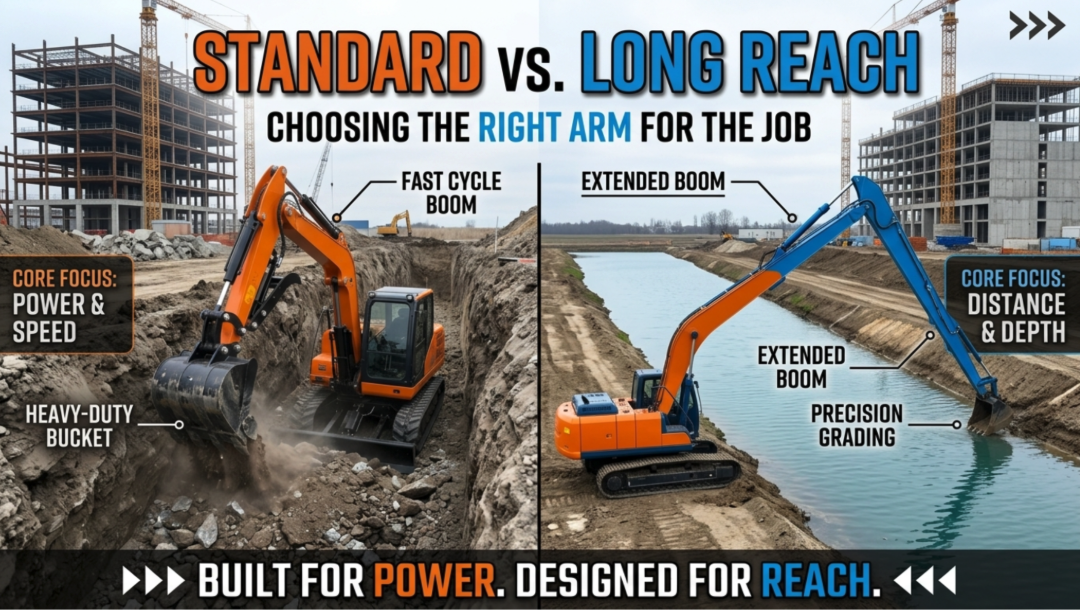
The result of a project from the initial excavation to the final cleanup is determined by the choice of excavator arm. Although long reach and standard arm machines appear similar at first glance, they are designed to address somewhat different issues. One trades strength for the capacity to reach over distances that a typical machine cannot, while the other is designed for power and quickness in daily tasks. If you select the incorrect one, you run the risk of a machine that is unable to perform the task at hand, hazardous instability, or sluggish development. These two designs are not superior to one another; rather, each is designed to perform a particular type of work, and the skilled operator knows which is which.This guide breaks down five key factors that should drive your decision, covering how each design matches the task, how far and deep they reach, how they handle heavy lifting, how fast they work, and what they cost to move and maintain. Being aware of these distinctions enables you to optimize each shift by matching the machine to the task. These guidelines can help you make the appropriate decision whether you are purchasing new equipment, renting for a single task, or just choosing which fleet unit to send out. By the time it's all over, you'll have a clear framework for balancing reach versus power, speed versus accuracy, and convenience versus capability to ensure a successful and profitable next excavation.
Match the Machine to the Job
The most important step in choosing between these two designs is being honest about the work you actually do day to day. Standard arm excavators are the dependable choice for the vast majority of excavation tasks. They handle trenching, foundation digging, and moving heavy piles of dirt with the strength and control those jobs demand. For routine site work, the standard arm is almost always the right tool because it delivers power exactly where most operators need it. A long reach arm, by contrast, earns its place only when the job genuinely requires extended reach, such as working across wide water or down deep banks where you cannot safely drive the machine closer. The trouble starts when operators reach for a long reach machine simply because it sounds more capable. That extra reach comes with real trade-offs in strength, speed, and stability, so it should only be chosen when the distance is truly unavoidable.
Picture a crew clearing a drainage channel they can stand right beside. A standard arm finishes that work faster and more safely, with the power to move material quickly and the stability to do it without fuss. Now picture dredging the center of a wide pond from the bank, where no machine can safely drive close to the work. Only a long reach arm can get there, stretching across the water to pull material the standard machine could never touch. Matching the machine to the genuine demands of the site, rather than to its impressive specifications, is the foundation of an efficient and profitable operation. Start every job by asking what the work truly requires, and the right choice usually becomes obvious.
How Far and How Deep You Need to Go
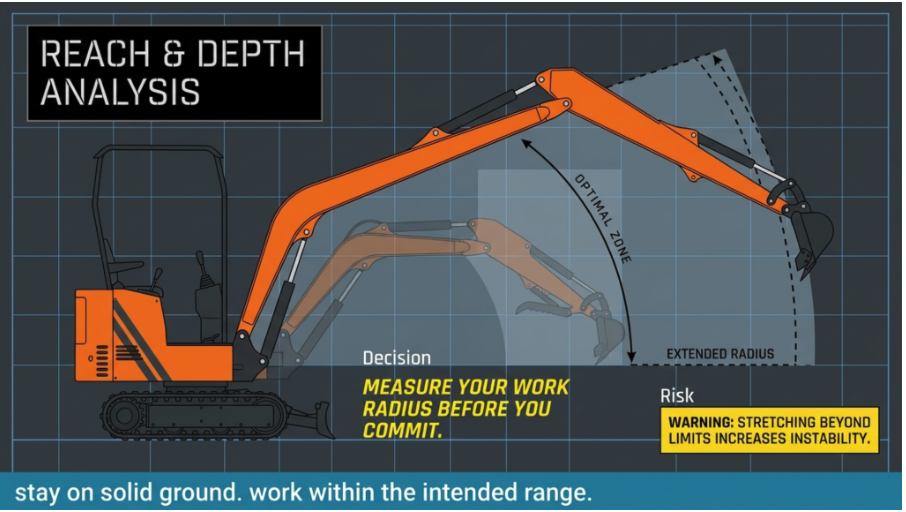
Reach is the defining difference between these two machines, so measuring the distance your work demands is essential before you commit. Start by studying where the material actually sits in relation to where the machine can safely stand. If your digging always happens close to the tracks, a standard arm gives you everything you need with better control and stronger performance. If you find your crew constantly fighting to reach the center of a ditch, the far side of a bank, or the middle of a pond, that struggle is a clear sign the standard arm is being pushed beyond its comfortable range and a long reach machine would serve you better. The cost of getting this wrong shows up in wasted time and added risk.
When weighing reach against the work in front of you, these distinctions help clarify the decision:
A standard arm is ideal when all work stays within a short, comfortable reach of the machine, and it handles normal trench depths and close-up excavation with precision.
A long reach arm covers horizontal distances a standard machine cannot safely stretch to, reaching deep into ponds, ditches, and steep banks without constant repositioning.
An operator straining a standard arm to its absolute limit works slowly, strains the machine, and may edge the tracks dangerously close to an unstable bank just to gain a few extra feet. That is exactly the situation a long reach arm is built to prevent, since it lets the machine stay on solid ground while the arm does the reaching. On the other hand, using a long reach machine for close work means dealing with slower, more deliberate movements that a standard arm would breeze through. Knowing the true distance and depth your work requires keeps you from buying or renting more reach than you need, and it keeps your crew working safely within the machine's intended range.
Lifting Heavy Weights
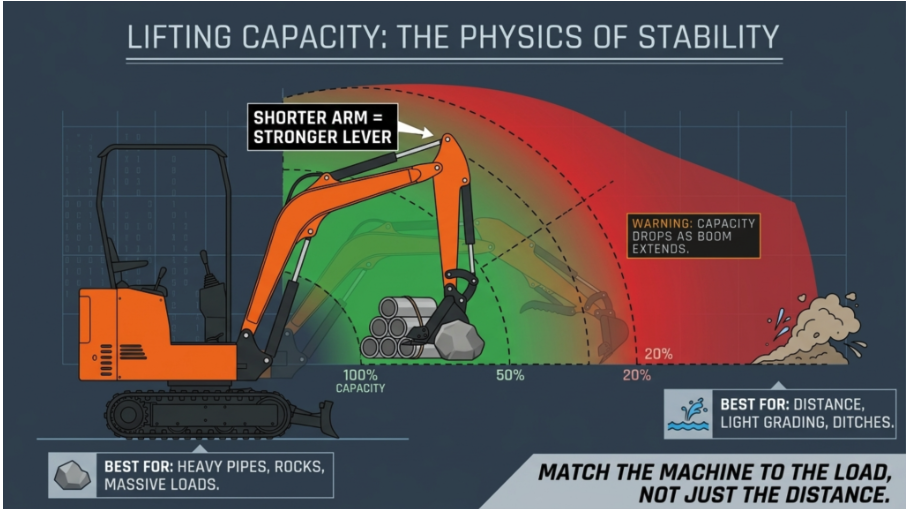
Lifting capacity is where standard arm excavators show a clear and meaningful advantage. Because their arms are shorter and more compact, the load stays closer to the body of the machine, which keeps the center of gravity stable and the lifting power high. This makes standard arms the obvious choice whenever the job involves setting heavy pipe, hoisting large rocks, or moving substantial loads around the site. The shorter arm acts as a stronger lever, giving the operator confidence that the machine can handle weight without straining or losing its footing. For any task built around lifting, the standard arm is the safer and more capable tool, and it gives you the margin you need to work without second-guessing every move.
The physics behind this is straightforward and unforgiving. A long reach arm places the load far from the machine's center, which creates enormous leverage working against stability. The farther the arm stretches, the easier it becomes to overturn the entire excavator, even with a load that a standard machine would handle without effort. Long reach arms are engineered for distance, not lifting power, so their capacity drops sharply as the boom extends, and they can tip dangerously if asked to lift heavy loads while fully stretched out. Attempting heavy lifts at full extension with a long reach arm is one of the most common causes of tip-over incidents with these machines, and the results can be costly or even tragic. If your work regularly involves lifting and placing heavy objects, a standard arm protects both your crew and your equipment. Reserve the long reach machine for tasks where reach matters most and the loads stay light enough to handle safely at distance, and never push it beyond what its design can support.
Speed of Work
Production speed often decides the profitability of a project, and the two arm designs work at very different paces. Standard arm excavators are built for quick, efficient cycles. Their compact design lets the operator dig, swing, and dump in fast, repeating motions that move large volumes of material in a short time. For routine site preparation, trenching, and earthmoving, that speed translates directly into more work completed per shift. When the goal is to clear ground or dig efficiently, the standard arm keeps the project moving at a productive, profitable rhythm that long reach machines simply cannot match. Every fast cycle adds up over the course of a day, and on a large job that difference in pace can decide whether you finish on schedule or fall behind.
The reason for this difference lies in how each machine is meant to be used. A long reach arm carries more weight at the end of a much longer boom, so operators must move it carefully and deliberately to keep everything stable and accurate. That measured pace is exactly right for delicate work like cleaning a canal bank or grading a slope from a distance, where precision matters more than raw speed. The slower, controlled movement is a feature rather than a flaw when the task calls for finesse over volume. Used for ordinary digging, though, that same caution becomes a drag on productivity, turning a quick task into a slow one and eating into your margins. Matching the machine's natural working speed to the demands of the job keeps your crew efficient. Choose the standard arm when output and pace matter, and accept the slower, more careful rhythm of a long reach machine only when the reach itself is the priority and precision is what the work truly demands.
Transport and Upkeep
The costs of owning and operating an excavator extend well beyond the dig, and transport and maintenance differences between these machines are significant. Standard arm excavators are far easier to live with on this front. Their compact dimensions allow them to load onto a standard trailer and travel between sites without special arrangements. They also tend to cost less to maintain, since their components are conventional and built for the everyday stresses of normal work. For a contractor moving frequently between jobs, the standard machine keeps logistics simple and operating costs predictable, which protects the bottom line over the long run and removes a great deal of hassle from your schedule.
The long reach machine's size and complexity create ongoing expenses that are easy to overlook at purchase. The practical differences are worth laying out plainly:
Standard arm loads onto a regular trailer, moves between sites with ease, and costs less to maintain thanks to conventional, durable components.
The long reach arm is larger and more awkward, often requiring a special trailer to haul, and demands more frequent and costly maintenance on its extended parts.
Those extra-long boom and arm sections are heavier and harder to transport, which can mean specialized hauling equipment and added permits for every move. The long components also face greater stress during operation, so pins, cylinders, and structural parts often wear faster and cost more to service. A machine that sounds versatile on paper can quietly drain a budget through transport headaches and repair bills if it is used for work that never truly needed the reach. Weighing these practical ownership costs against how often you actually require extended reach helps you avoid paying for capability you rarely use. For most operations, the standard arm offers the better balance of convenience and affordability, with the long reach machine reserved for the specialized jobs that justify its added expense and the logistics that come with it.
Conclusion
When deciding between a long reach and a normal arm excavator, it's important to be honest about the tasks you perform most frequently. For most projects, standard arm machines are the best option since they provide the strength, speed, and affordability that daily digging, lifting, and site preparation require. In order to reach over wide rivers and down deep banks where no ordinary equipment can safely work, long reach machines must sacrifice lifting strength, speed, and ease of transportation. You will find the excavator that maintains your business lucrative, safe, and productive if you match the machine to the actual needs of your job sites and balance the additional expenses against the frequency with which you actually need longer reach. Review the work ahead of you, measure your real reach and lifting needs, and choose the design that fits the way you actually work.
https://youtu.be/BE5VGSnrx2w?si=VFad_zYRDKwK5bZM
NewExcavatorsfor Sale
High-quality, compact construction equipment and attachments, including mini
Support
TYPHON Machinery Offices
2522 S Malt Ave. Commerce, CA 90040 United States
Phone Support
Sales : +1 213-214-2203
Logistic : +1 626-389-2472
Sales : Sales@typhonmachinery.com
Logistic : Logistics@typhonmachinery.com
Tech Support : Support@typhonmachinery.com
newexcavatorsforsale © 2025. All rights reserved.