
How To Use Mini Excavator Controls
Learn how to operate mini excavator controls with ease. Understand levers, joysticks, safety steps, and techniques for smooth and efficient digging.
MINI EXCAVATOR CONTROLS
11/24/20256 min read
How To Use Mini Excavator Controls
Mini excavators are small, flexible machines that have turned out to be necessary in different projects of the building industry, landscaping, and demolition.
Knowing the simple controls of a mini excavator is the first step for an operator as it is the basis for an efficient and safe operation.
The central elements of these controls are the joystick and foot pedal systems through which an operator can move the machine with great accuracy.
Generally, mini excavators have two joysticks: one to control the boom and the arm, and the other to control the swing and the movement.
Moreover, the joysticks are made in such a way that they provide an easy control; thus, operators can implement complex tasks with very little effort.
Besides the joysticks, mini excavators also have foot pedals to operate the machine's tracks. With these pedals, the driver can make the excavator move forward or backwards, or rotate in place.
Knowing the interrelation of these controls is a must for a flawless run.
For example, while digging, an operator should synchronize the movement of the boom and the arm with the machine's travel to keep it steady and safe from falling over.
Being skilled in these simple controls will not only boost the worker's output but also lower the chance of injuries happening on the site.
Key Takeaways
Know the basic controls and functions of mini excavators to be able to operate them effectively.
Work on the use of joystick and foot pedals to achieve more accurate digging and maneuvering.
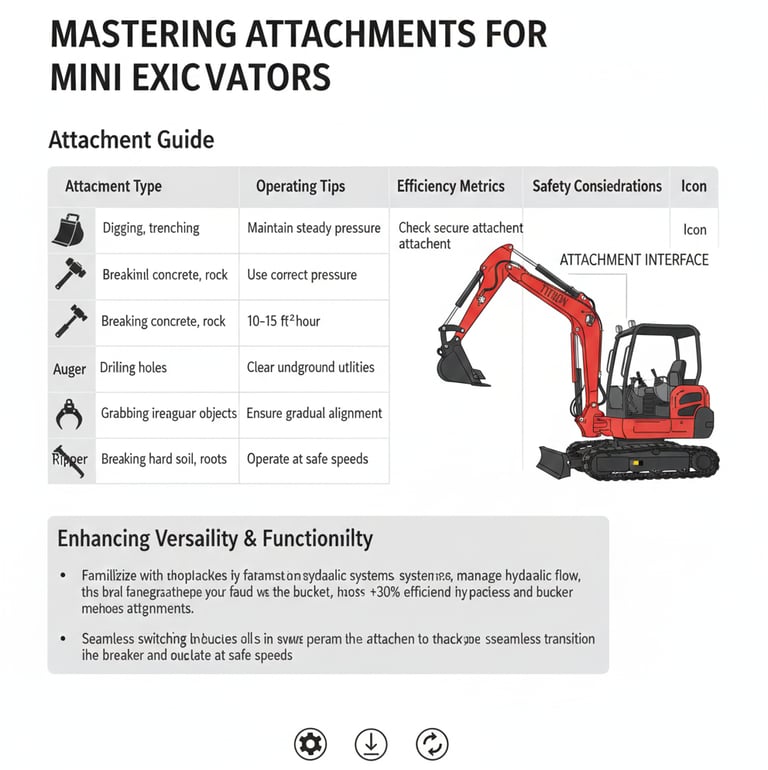
Learn how to handle attachments to your mini excavator to increase its versatility.
Observe the safety regulations and take the necessary precautions to guarantee safe and efficient operation.
Employ advanced methods and follow troubleshooting suggestions to raise your performance and productivity level.
Familiarizing Yourself with the Joystick and Foot Pedal Functions
Mini excavator joystick control is a typical example of how technology is used to provide different maneuvering options. The left joystick normally controls the rotational and lateral movement functions, allowing the operator to turn the machine and move it sideways.
The right joystick, in essence, is used for controlling the upward movement of the boom and the extension of the arm.
Every movement of the joysticks is converted into machinary movements, so it is very important for operators to learn and get used to their functions. By way of illustration, moving the left joystick forward might make the machine go forward and at the same time, by pulling it back a reverse motion can be initiated.
Foot pedals bring other kinds of control, especially in the area of track movement. The right foot pedal generally controls the movements of the machine in the forward and backward directions, whereas the left pedal can be used for other functions such as controlling auxiliary hydraulics or stabilizers.
Knowing how to work with these pedals along with the joysticks is absolutely necessary if one is to be able to control the movements accurately. As an example, if an operator is digging a trench, he or she may have to move the machine forward, lower the boom and extend the arm, all at the same time.
Being in control of the equipment enables one to do it smoothly which in turn is very important if there is not much room or if working around obstacles.
Learning to Maneuver the Mini Excavator for Precision Digging
Precision digging is an art that can only be achieved with practice and thorough knowledge of the effective manipulation of a mini excavator. To master this skill, one of the main move is to learn how to position the machine prior to the actual digging operation.
Correct placement refers to the situation where the equipment is set up in a manner that the digging area can be accessed quickly without any incorrect movement or repositioning.
This stage of the work not only is it time-saving for the operator but, also it lessens the wear and tear of the machine and makes the environment safe from it. After the operators have positioned themselves, they must coordinate their motions by using both the joysticks and the foot pedals.
Thus, while digging a trench, an operator can lower the boom and simultaneously move forward in order to keep the depth of the trench constant.
Furthermore, the center of gravity of the machine should always be taken into consideration. Stability is extremely important when working on uneven ground or near edges.
To develop a higher degree of movement-accuracy, operators are recommended to make it a habit of small soundness adjustments in their movements.
Such regard for precision could consist of using slow, intentional movements rather than rapid, jerky motions, which could result in errors or even accidents.
Mastering the Art of Operating Attachments with the Mini Excavator
Tips for Improving Efficiency and Productivity with Mini Excavator Controls
Speeding up the productive power of a mini excavator is a skill and a strategy at the same time. To start with, a good and effective tip would be planning every single task even before one gets to the job.
That would involve not only evaluating the job site and finding the obstacles but also working out the most energy-saving sequence of operations.
Once the operator has all the steps in his/her mind, he will be able to eliminate the movements that don't contribute to the work and thus flow his/her tasks more smoothly. The productivity may also be raised through permanent attention to the working condition of the machine and the tooling.
Taking care of the parts should be a prevention of the eventual breaking-down and therefore, a rest from the work. Apart from this, the operators need to polish their skills through the training courses they attend.
The manufacturers hold mainly technical and best practice instruction sessions for the efficient use of mini excavators. This shows a path for an ongoing skill-building journey and job-site productivity increase.
Safety Precautions and Best Practices for Operating a Mini Excavator
Introducing safety as the main concern should be a given while dealing with a mini excavator. An inseparable one from safety disciplines is a hard and thorough daily check of the working-condition and the safety of the machine.
Checking fluid levels, watching the hydraulic hose for leaks, and assuring that all the safety features are correctly working are among the things to be done.
The next advice that the operators should not forget is to learn the machine’s safety manual by heart and to follow the instructions to the letter.
Along with that, they must keep an eye on the world surrounding them when performing their tasks.
They have to check for power lines above them, pedestrians walking by, and other machines that are near the area. Keeping a safe distance from where danger can come from is a good way of stopping accidents before they happen.
Besides that, they should also use the right personal protective equipment (PPE) such as hard hats, gloves, steel-toed boots, to reduce the chance of getting hurt in an accident.
Troubleshooting Common Issues with Mini Excavator Controls
Even skilled operators may find trouble with the mini-excavator controls once or twice. One issue frequently mentioned is the unresponsiveness of the joystick(s) and foot pedal(s) that could be due to hydraulic system problems or could be of electrical nature.
If any operator sees that the controls are slow or do not react to the commands in the right way, it is very important that he/she immediately stops the operation and makes a detailed check of the hydraulic and the electrical parts (lines, connections). Other problems most often talked about, in this case, are those concerning attachment compatibility or performance issues.
For example, if the attachment is not working properly or it seems that it is loosening during the operation, then probably it is not that it is simply not fixed securely but that there is an issue of the hydraulic flow causing it.
The operators should solve the problems faced by them in this domain first by consulting their machine manual and then by checking their machine and attachments thoroughly.
They might learn self-troubleshooting techniques until they get to the bottom of the issues. Moreover, routine service and inspection will also keep most of the common problems at bay.
Advanced Techniques for Experienced Operators to Enhance Control and Performance
Experienced operators pursuing to refine their skills may consider the performing of advanced techniques which in turn can lead to the amplification of operator’s control and the machine’s performance to the highest levels. The foremost example of this skill development is the perfection of simultaneous movements by means of both joysticks and foot pedals.
Skillful operators can figure out ways to initiate almost double or triple maneuver combinations at the same time, i.e., the partial rotation by the cabin while the digging operation is being done can be made continuous thus achieving higher efficiency.
Another advancement can be purchased in the field of precision grading when working on detailed development plans or areas that require very exact measurements. This task involves the use of the appropriate attachments, for example, grading buckets or laser-guided equipment, which help maintain continuity in both depth and slope during excavation work.
By applying the use of technology in their work, proficient operators achieve greater accuracy in their tasks while at the same time lowering the amount of manual work needed. Furthermore, the concept of managing the load becomes very important for advanced operators those who are often handling heavy materials or working in difficult situations.
It requires an understanding of how much load the operator’s mini-excavator is capable of carrying at any time without affecting the balance or the performance negatively.
The experienced operators are able to ex-cell their skill by bringing out these strategies in real act, meanwhile, they continue to strive for improvements thus reaching their effectiveness to the maximum level while safety is always on the top of their priority list served throughout all their operations.
NewExcavatorsfor Sale
High-quality, compact construction equipment and attachments, including mini
Support
TYPHON Machinery Offices
2522 S Malt Ave. Commerce, CA 90040 United States
Phone Support
Sales : +1 213-214-2203
Logistic : +1 626-389-2472
Sales : Sales@typhonmachinery.com
Logistic : Logistics@typhonmachinery.com
Tech Support : Support@typhonmachinery.com
newexcavatorsforsale © 2025. All rights reserved.