
The Role of the Excavator Chassis in Machine Durability
Explore how excavator chassis design, material strength, and structural integrity directly impact heavy equipment durability and long-term performance.
3/16/20265 min read
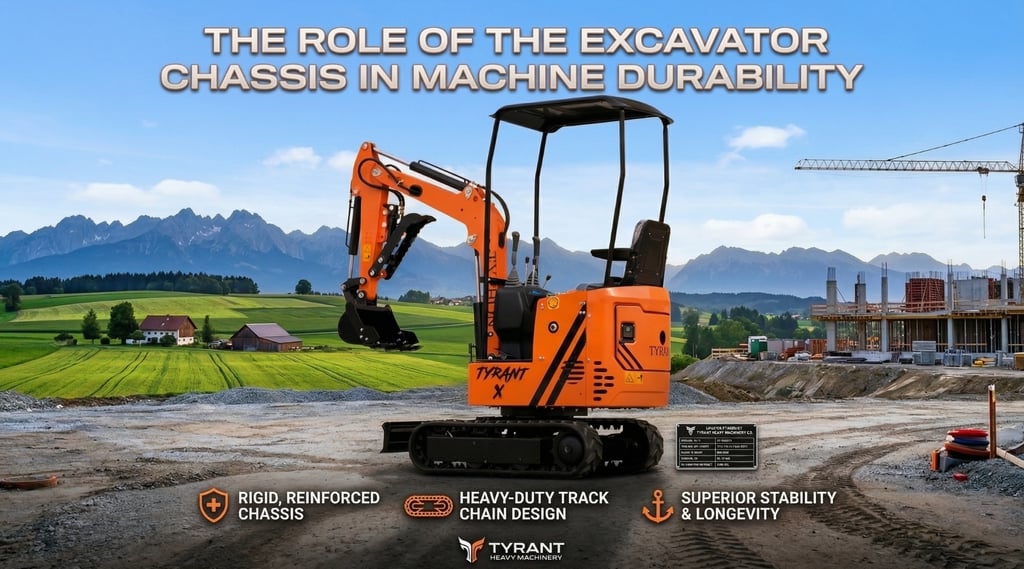
The power of an excavator is often linked to its engine and hydraulic system. While these components are essential, the machine’s durability and stability depend heavily on a more fundamental part: the chassis. Also known as the undercarriage, the chassis forms the structural base of the excavator. It supports the machine’s weight, absorbs the intense forces generated during digging and lifting, and withstands constant exposure to rough job site conditions. A strong, well-built chassis plays a major role in determining whether a machine will perform reliably for years or face early structural problems and costly downtime.
For contractors and equipment owners, understanding the importance of the excavator chassis is key when assessing long-term equipment value. Although it may not come with horsepower figures or eye-catching features, the quality of its design and construction often reflects a manufacturer’s focus on durability. A solid chassis allows the excavator to convert its power into productive work while maintaining structural stability.
This guide explores the critical role the excavator chassis plays in overall machine durability. It highlights the design elements—from material strength to structural engineering—that help machines handle demanding workloads and explains how a well-built chassis contributes to dependable performance over time.
The Foundation of Strength: What is an Excavator Chassis?
An excavator’s chassis is the lower frame assembly that houses the tracks, rollers, idlers, and final drives. It is the mobile platform upon which the entire upper structure—the cab, engine, and boom—is mounted via the swing bearing. The chassis serves multiple critical functions simultaneously. It must support the total weight of the machine, provide a stable base for digging and lifting operations, and propel the excavator across rough and uneven terrain.
Every force generated by the machine is ultimately transferred through the chassis and into the ground. When the bucket bites into hard soil, the stress travels up the arm, through the boom, into the upper house, down through the swing bearing, and is finally absorbed by the chassis. This constant cycle of intense loading and unloading means the chassis is perpetually under extreme stress. A failure in its design or construction will inevitably lead to a catastrophic failure of the entire machine.
Material Strength and Weld Integrity: The Building Blocks of Durability
The durability of an excavator chassis begins with the quality of the materials used in its construction. Modern heavy equipment manufacturing relies on high-tensile strength steel, an advanced alloy engineered to withstand extreme forces without bending or fracturing. Using superior-grade steel is non-negotiable for building a chassis that can endure the demanding lifecycle of an excavator.
However, the quality of the steel is only part of the equation. How those steel components are joined together is equally important. The integrity of the welds that form the chassis structure is a critical factor in its overall strength. In high-performance excavators, like those engineered by Typhon Machinery, robotic welding is often employed for key structural joints. This automated process ensures a level of consistency and penetration that is difficult to replicate manually. A perfect weld creates a seamless bond that is as strong, or even stronger, than the parent metal, distributing stress evenly across the structure.
Conversely, poor-quality welds create weak points. An incomplete or improperly fused weld becomes a stress riser—a single point where forces concentrate. Over time, the constant flexing and vibration of normal operation will cause microscopic cracks to form at these weak points. These cracks can propagate through the structure, leading to major frame damage that is often complex and expensive to repair.
Structural Design for Resisting Torsional Forces
An excavator rarely operates on perfectly flat, level ground. More often, it is navigating slopes, crossing ditches, and maneuvering over debris. In these situations, the chassis is subjected to powerful twisting, or torsional, forces. As one track climbs over an obstacle while the other remains on lower ground, the entire frame is twisted. A poorly designed chassis will flex excessively under these loads, putting immense strain on welds and a machine's critical components like the swing bearing.
Superior chassis design incorporates features specifically intended to resist these torsional forces. Engineers use techniques like boxed-section frames, where steel plates are welded together to form strong, hollow beams. This design provides exceptional rigidity while keeping weight to a minimum. Strategic placement of internal cross-members and gussets further reinforces the structure, preventing it from twisting under load.
A rigid, well-braced chassis ensures that the upper structure remains on a stable platform. This stability is critical not only for durability but also for operator comfort and safety. It also protects the swing bearing, one of the most precise and expensive components on the machine, from the uneven stresses that a flexing frame would impose upon it.
The Undercarriage Components: Durability in Motion
While the chassis frame provides the machine’s main strength, the real test of durability lies in the moving undercarriage components—tracks, rollers, idlers, and sprockets. These parts are constantly exposed to dirt, sand, and rocks, which puts them through relentless wear and tear.
The lifespan of these components depends heavily on the quality and hardness of the steel. Top-grade rollers and idlers are forged and heat-treated to resist abrasion while keeping a core that absorbs shocks. Just as crucial are the bearing seals, which prevent dirt and water from entering and causing early failure.
Maintaining the correct track tension is another key factor. Tracks that are too loose risk derailing, while overly tight tracks wear down parts faster. Today’s mini excavators are designed for easy tension adjustments, allowing operators to keep the undercarriage in optimal condition and extend its service life.
The Impact of Chassis Durability on Overall Performance
A durable chassis does more than just prevent structural failures; it directly enhances the machine's overall performance and productivity. A strong and stable chassis provides the solid foundation needed for the hydraulic system to work at its full potential.
When an operator makes a heavy lift over the side of the machine, a robust chassis minimizes rocking and flexing. This stability gives the operator the confidence to work faster and more efficiently. It also allows for more precise grading and trenching, as the digging edge of the bucket remains steady and predictable. This precision reduces the need for rework, saving time and fuel.
Furthermore, a well-designed undercarriage improves the machine's travel performance. Smooth-rolling components and an efficient final drive design reduce the amount of engine power required to move the machine, improving fuel economy. A durable chassis ultimately translates into a more reliable and profitable machine over its entire service life.
Conclusion
The excavator chassis may not be the most celebrated component, but it is undeniably one of the most important. It is the unseen pillar of strength that supports every function of the machine. From the quality of its steel and the precision of its welds to the robust design of its moving parts, every aspect of the chassis contributes to the excavator's ability to perform reliably in the toughest environments.
When investing in heavy equipment, it is essential to look beyond the specifications of the engine and hydraulics and critically evaluate the construction of the undercarriage. A commitment to high-quality materials and superior structural engineering, as demonstrated in any equipment, is a clear indicator of a machine built for durability. A strong chassis ensures greater safety, better performance, and a higher return on investment, making it the true foundation of a productive and profitable operation.
NewExcavatorsfor Sale
High-quality, compact construction equipment and attachments, including mini
Support
TYPHON Machinery Offices
2522 S Malt Ave. Commerce, CA 90040 United States
Phone Support
Sales : +1 213-214-2203
Logistic : +1 626-389-2472
Sales : Sales@typhonmachinery.com
Logistic : Logistics@typhonmachinery.com
Tech Support : Support@typhonmachinery.com
newexcavatorsforsale © 2025. All rights reserved.